
On Majorities
A short comment on revolution, democracy, and contemporary fascism

Large parts of the left seem to espouse a myth. It claims that the political achievements of the last few centuries were won by “the people”, which is imagined as the real majority of the population. This democratic illusion serves a purpose; by obfuscating the actual mechanism of change, it invokes the Big Other of popular consent and retroactively legitimizes the victories of the left. While this might make for good propaganda, it misrepresents reality. Those who are ill-acquainted with the real world make for bad strategists.
The majority of the population exists as an unorganized mass, a “sack of potatoes” according to Marx. This sluggish lump of individual people or families is apolitical at best and often deeply reactionary. Historical progress has always originated with the more structured elements of society, above all the reading public and the organized workforce. The power of these social organs did not result from pure numerical strength – their members were always a minority – but from a disproportional degree of organization and cooperation.
The French Revolution, for example, could never count on the support of the majority of the French. The peasant masses were apathetic or even hostile towards it. However, it had the support of educated circles and those parts of the Parisian middle and lower strata that formed the so-called sections. While these “sans-culottes” were common people in every sense of the word, they were still a small minority of the total population. But since they were highly organized and motivated activists, they controlled Paris.
The more radical – and nominally more inclusive, more democratic – currents of the revolution, Robespierre’s Montagnards, were also the least popular with the mass of the French populace. When the Girondins threatened to “march France upon Paris”, they expressed the (correct) belief that the majority opposed the radicalism of the sections and the revolutionary clubs. Robespierre and the sans-culottes however were not stupid. Instead of accepting the “will of the majority”, they simply took power by force. Those who want to know what ordinary Frenchmen thought about all of this should study the Vendée uprising.
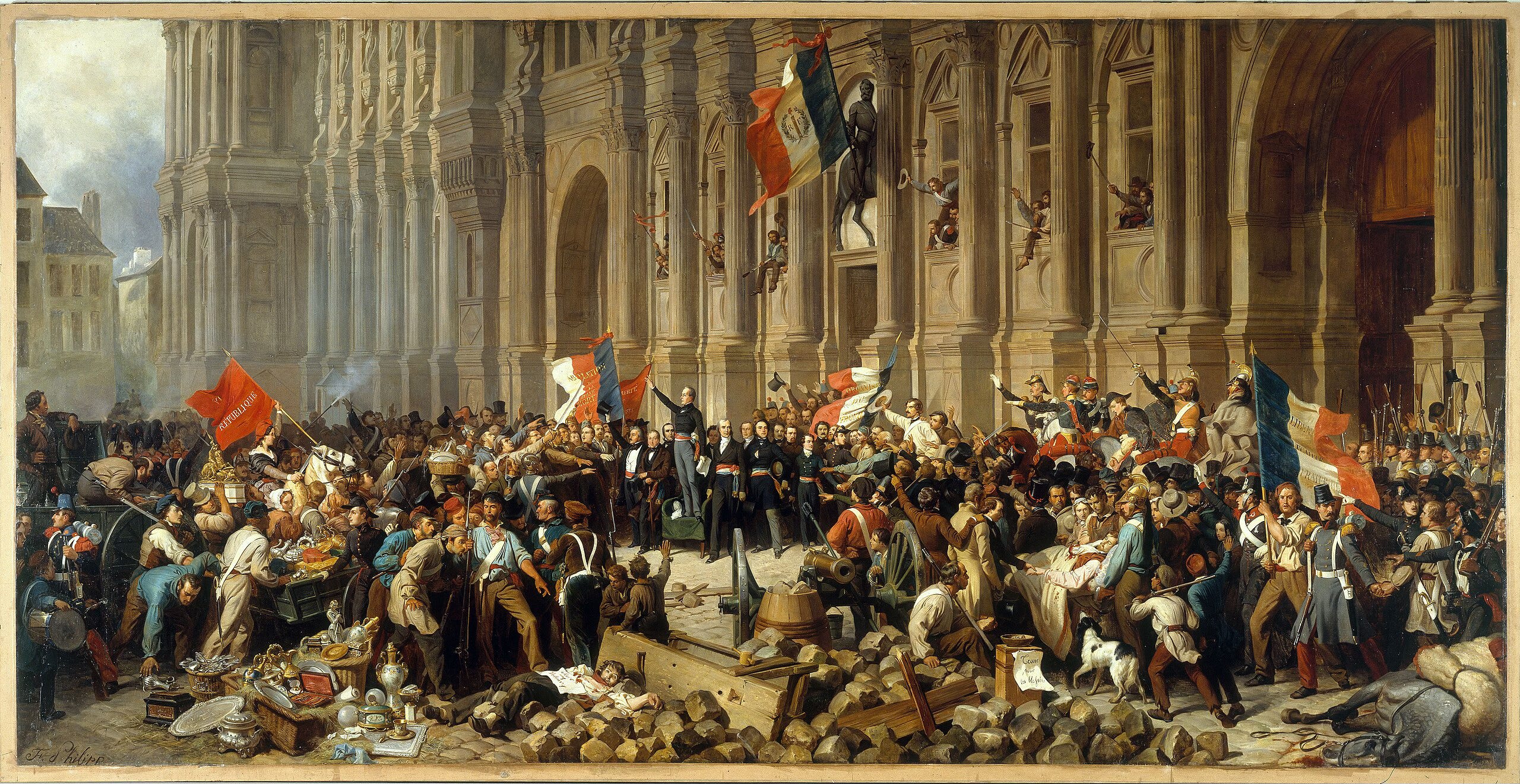
During the 1848 revolution, the masses were likewise on the side of reaction. Again it was an activist core of workers, artisans, students, and intellectuals which toppled the rule of the House of Orleans. They declared a republic and scheduled elections. When the results were in, conservative elements emerged victorious. A few revolts and coups later, a “second empire” was proclaimed under Napoleon III. Its base of power: the masses.
The same story with the Russian Revolution. One of the first steps of the red movement was the dissolution of the Constituent Assembly, a democratically elected parliament. Elections had favored the right wing of the Socialist Revolutionary Party, opposing the rule of the worker’s councils and thereby threatening the revolutionary project. Unwilling to cede power to a body elected by the backwards peasant mass, the activist minority of the large industrial cities shut down the assembly.
Russia, of course, was a primitive, peasant country. Any revolution in a modern industrial nation would not face the peasant problem. Nevertheless, it is highly unlikely that anything resembling a truly socialist programme could count on immediate majority support. The point where the urban workers and activists are powerful enough to overthrow the government will always come before any numerical majority may be secured.
This should not be read as advocacy for Stalinism, that is bureaucratic-authoritarian state socialism. Long-term suppression of basic republican principles such as the freedom of speech coupled with the destruction of self-organized, grassroots-level initiative will inevitably lead to the death of the revolution. Once all power has been taken from the reading public, the organized workforce, and the socialist movement, the social base of the revolution is gone. Once the state apparatus monopolizes violence, everything must end in failure and corruption.
The dictatorship of the proletariat is not democratic majority rule, but it is also not one-party rule. It is the rule of the collective revolutionary movement. This movement may suspend civil liberties only as a short-term emergency measure; a year or two in which all forms of organized resistance to the revolutionary project can be neutralized. The basic bourgeois liberties are then to be fully restored. The economic and cultural programme of the revolution must be implemented rather quickly. After perhaps a decade, the new state of affairs will be sufficiently normalized. The conservative instincts of the unorganized mass will no longer pose a threat, and complete democracy can – and must – be introduced.
Historical progress relies on the primacy of the activist minority over the passive majority. It relies on a practical monopoly on the means of communication by the left-leaning social organs, in practical terms by intellectuals, artists, trade unions, and journalists. This state of affairs has been the norm in Western democratic countries before the introduction of the internet. Furthermore, the hegemony of the reading public and the organized workforce has to be passively accepted by the unorganized mass. This acceptance corresponds to what we might call “belief in progress” or “belief in modernism”.
In the 1980s, the organized workforce was defeated by the neoliberal assault orchestrated by Margaret Thatcher, Ronald Reagan and their disciples. Then, the internet challenged the monopoly on communication of the left-leaning social organs. Finally, the so-called woke movement not only discredited the reading public, but also enraged and activated the unorganized mass. The belief in progress had already been severely weakened by the failures of 1848, 1919, and 1968. The death of the “hauntological left” (ca. 2015 to 2020) has further eroded the credibility of the modernist project of the revolution. We are thus faced with a hostile mass. This is the recipe for fascism.
All carriers of historical progress are gone. Not only is it currently impossible to improve the world, it is even questionable whether past gains may be successfully defended. Our most basic liberal and republican constitutional rights are under severe threat. The separation of powers, freedom of speech, and international legal standards were never interesting to the majority of the population. They were only upheld (even if selectively) by the pressure of the reading public, which, although numerically weak, possessed a degree of moral authority and institutional power.
There are but two options. Either we manage to rebuild the power of the organized workforce and the reading public, or our world will be ruled by capitalists, bureaucrats, and howling mobs until the time it finally breaks.